
The Arch
A monologue in two parts. Written somewhere in 2020

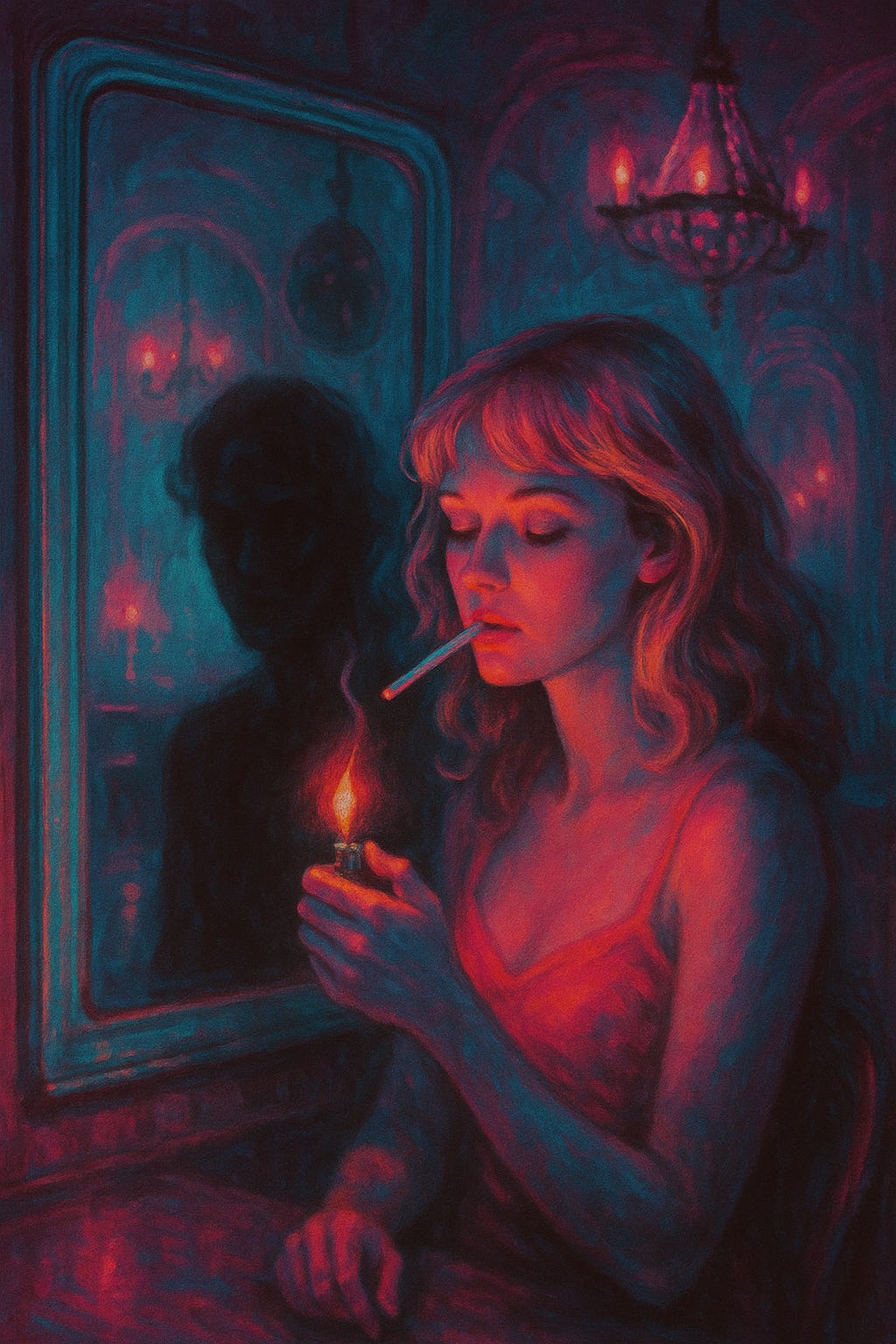
This one is for wonderful doctor, engagement that never happened and hope he’s still alive.
I miss you. And I do not remember you. No name. No face. That’s a curse
Every morning, I walk through the arch.
From darkness into light.
Not because I believe in light, but because I need to know it’s still there.
There was a time the whole universe was only shadow.
The Gods had no shape.
They played with barely-burning stars,
pushed off imaginary matter just to feel motion.
They were bored.
The era of wine-soaked melancholy was still billions of years away.
If we rewound the tape back to the first flicker I think we’d see it:
the idea of life.
Not meaning. Not morality. Just endurance.
A little body. A little human.
Something that could keep going.
They made one.
Then another.
Then the whole thing spun loose.
People spilled into the cosmos.
Too many. Too loud.
So the Gods built a container.
A garden.
An aquarium.
One green place to hold us.
Because the Gods don’t share well.
Time passed.
Land changed hands.
Bodies came and went.
The sun moved closer, then away.
Someone disappeared.
Someone was born.
And then one morning
an autumn one
I arrived.
I didn’t ask to.
No one asked me.
But I arrived anyway.
Fingertips humming with leftover starlight.
I saw what the Gods had abandoned.
I saw what humans built anyway.
Light.
Carved by hand.
I didn’t want to beg for it.
So I held the universe in my palms.
Walked through the prism.
Let the wave bend.
Let the particle split.
I filled myself with light.
And I knew
somewhere deep
one day, I would be the one
to give it back.
Every night, I walk through the arch again.
This time from light into dark.
There were nights I wanted to stay in the arms of particles.
But I couldn’t.
The rules won’t let me.
Streetlights are a lie.
A performance of safety.
The darkness doesn’t fear me.
It made me.
So I don’t resist.
My night is wrapped in thick curtains I stitched by hand, each pass of the needle splitting skin at my fingertips.
When I return to the beginning, the world shuts off.
There’s only dark. And it holds everything.
My fear.
My ache.
My joy.
My losses.
My tenderness.
My violence.
It is the cradle for my demons.
And for the twin who shared my mother’s womb.
He speaks to me.
Tells me to light another cigarette.
Says the glow will settle me.
And sometimes he’s right.
We talk.
I forget how to behave.
I do what the good girl wouldn’t.
Because I’m not her.
I’m the flicker.
The edge.
The one who knows
to give light you have to become the darkness that birthed it.
So those who carry only shadow
fall.
into despair
into me.
I don’t fight the dusk.
I don’t resist the night.
I let it live in me.
It feels like treason, like I’m selling off the light I once begged for.
It isn’t surrender.
It’s quite a strategy.
The only way to live beside darkness is to give it room.
You don’t conquer what you were born inside.
You hold it.
You let it speak.
You stop pretending it can be erased by will.
And so
I let it in.
Survival isn’t free.
Support the chaos that somehow makes sense
Truth is palatable —
just not polite.
I write it how it hurts.
Subscribe for honest essays,
dissociative satire, and
other inappropriate thoughts.
Dear Ms. Maruta,
Your poem is powerful. Pairing it with The Angry River intensified my experience...it carried that same haunting, slow‑burn gravity. The song is mournful, hypnotic, drenched in fatalism. Both poem and song share a sense of inevitability, of walking willingly into shadow because resistance is futile. Together, they transform into liturgy: a ritual of descent and return.
Walking through “the arch” becomes a threshold between light and dark. Gods bored with shadows, shaping stars and humans almost accidentally...it is a cosmic origin stripped of morality, where life is framed not as meaning but endurance. The “curse” of missing someone without name or face becomes longing for something intangible, a ghost of memory. And then the twin, the shadow‑self, whispering temptations, reminding us: “The only way to live beside darkness is to give it room.”
It feels like confession. You speak as both prophet and mourner, both creator and destroyer. The poem does not resolve into hope or despair...it insists on coexistence. Light and dark are not enemies; they are partners. To give light, you must carry darkness.
Reading it, I was tripping...in the best way. It destabilized the usual binaries and left me in a liminal space. Awesome.
I leave with a phrase from Wiccan ritual, emphasizing balance and coexistence.
In perfect love and perfect trust
Warmly,
Steve